
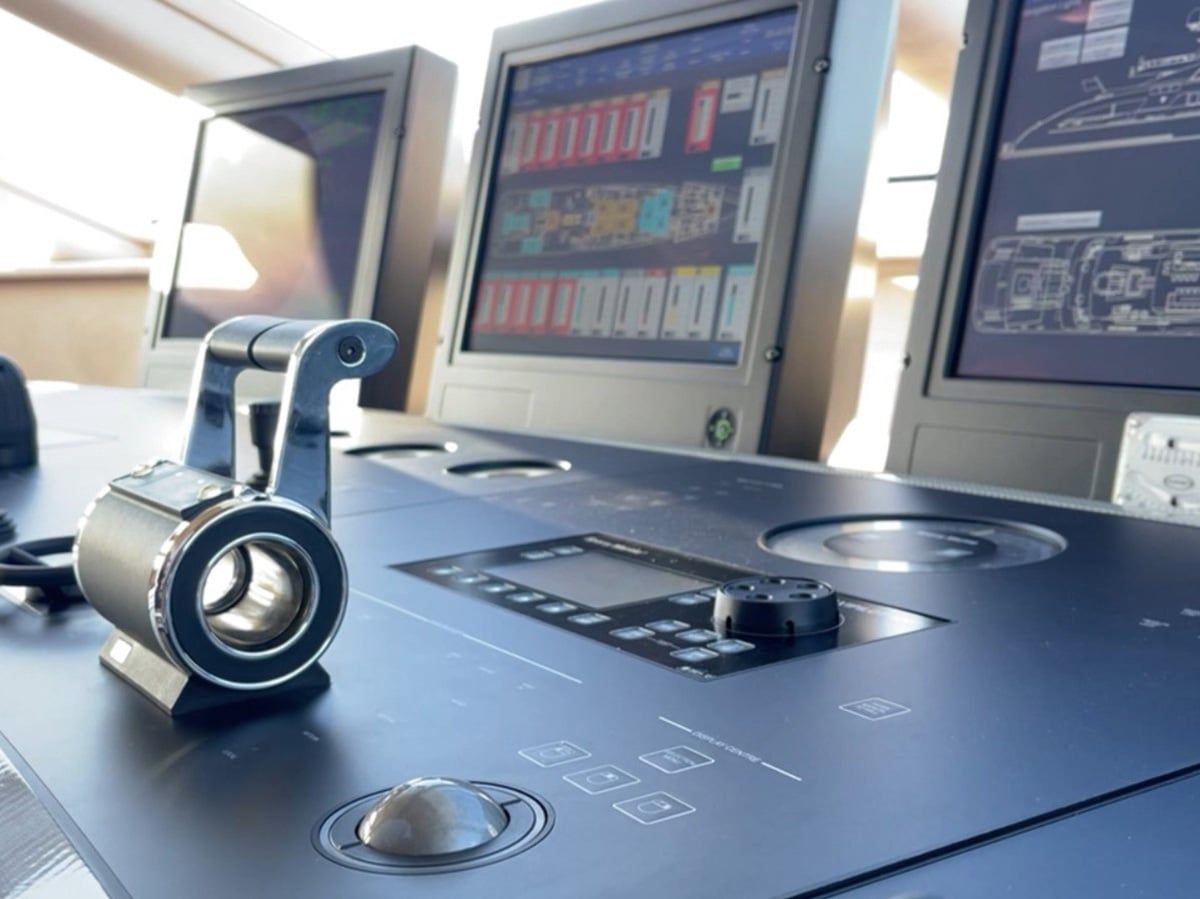
As a superyacht navigation management company, DSNM is constantly advising crews on the evolving complexities of safety and compliance. In recent months, the rise in GPS spoofing and jamming has been well-documented, particularly, in regions like the Eastern Mediterranean and the Gulf.
These incidents represent more than just a technical glitch; they disrupt the fundamental safety of the vessel, leading to confusion on the bridge and posing a potential threat to life. Whether it is an intentional act of electronic warfare or localised interference, the result is the same, a compromise of the vessel’s position. To discuss this escalating threat, we sat down with our in-house Master Mariner, Captain George Mills, to share his advice and professional opinion on making a bridge resilient to these digital threats.
The Anatomy of a Threat
Whilst sometimes used interchangeably, spoofing and jamming are two very different threats with their own purpose. However, they share the same goal of disrupting the integrity of the bridge.
Spoofing
A sophisticated deception where the vessel is fed false coordinates to deliberately take it off course. Worryingly, tests such as the White Rose of Drachs have shown that spoofing can be carried out successfully without triggering any bridge alarms. Giving it the nickname silent threat because the GPS and ECDIS continue to show valid, but false, positions.
Jamming
A brute-force attack, where a transmitter is used to drown out the satellite signal by broadcasting high-powered noise on the same frequency. It is important to note that attackers do not need sophisticated technology to commit a successful attack. Even a low-powered portable device can render a multi-million-pound navigation bridge blind.
Due to ongoing events in the Eastern Mediterranean and Gulf, there has been a shift from localised private attacks to large-scale state-sponsored interference.
Captain George Mills emphasises, “Without specific training, even a partial bridge blackout can create a state of chaos. Resilience on the bridge comes from a crew knowing how to identify deception and practising countermeasures long before an incident becomes an emergency.
This requires a constant effort to identify anomalies that do not match your physical surroundings. The International Chamber of Shipping (ICS) has recently released a poster on the dangers of GNSS failure, spoofing, and jamming. It highlights critical indicators to monitor, including:
- Investigate any significant mismatch between an AIS return and the physical radar echo.
- Routinely checking the radar image overlay against the ECDIS to verify GNSS data integrity.
- Recognising significant position jumps or track deviations that do not align with the passage plan.
In areas where satellite signals are known to be unreliable, these checks should be treated as a matter of course rather than a reaction to a suspected fault.”

The Realities of a Bridge Blackout
The most robust defence against issues on the bridge remains a well-trained crew. Whilst digital tools provide unparalleled convenience and access to data, over-reliance is becoming a growing risk.
The UK Maritime and Coastguard Agency (MCA) addresses this specifically in the MGN 379, serving as a critical reminder that electronic navigation is an aid, not a tool to be used in isolation. Compliance is more than having functioning equipment on the rack; it is about the continuous verification of data.
When spoofing or jamming occurs, the blue dot on the ECDIS ceases to be a legitimate primary source. In these moments, the safety of the vessel relies on the fundamental skills of traditional seamanship. It is here that the bridge team must transition their focus from automated position-keeping to active navigation. This means using every tool at their disposal, from parallel indexing on the radar to visual bearings to confirm their physical reality against the electronic display.
Captain George Mills highlights, “The moment GNSS data is suspect, the crew must transition to manual or traditional seamanship skills to verify, completely independently, what the satellite data is telling them.
It is imperative to immediately verify the vessel’s position using every tool available to confirm the physical reality against the electronic display.
Going back to the ICS poster, it recommends that bridge teams should:
- Switch the ECDIS to Dead Reckoning
- Plot manual fixes regularly to ensure the team remains proficient in traditional positioning.
- Verify GNSS position data against independent radar data as a matter of routine by using the standby ECDIS.
These steps ensure that the bridge remains a proactive command centre, rather than a passive receiver of potentially corrupted data.”
Responsibility to Report
Beyond the safety of the individual vessel, there is a broader duty to the maritime community. Interference is often regional, and early reporting can provide vital warnings to other yachts in the area. We encourage all bridge teams to utilise the USCG GPS Problem Report portal. By documenting the time, location and nature of the interference, crews contribute to a global database that helps maritime authorities monitor and mitigate these escalating threats.

Building a Resilient Bridge
Rather than waiting for the alarms to go off, bridge hardware suppliers such as NavigatX are providing proactive technical shielding solutions designed to identify threats before they become emergencies.
A key part of this defence includes products like the Furuno FFSP-100, recommended by NavigatX. This dedicated monitoring device provides automatic detection of anomalies. Through simple, intuitive visual cues, it alerts the bridge team the moment signal integrity is compromised, allowing for immediate action.
Additionally, specialised systems such as the FFGR-1 and FFGR-5 multi-constellation receivers support GPS, Galileo, GLONASS, and BeiDou simultaneously. By drawing from multiple satellite networks at once, these systems ensure that the bridge is never reliant on a single provider if one frequency is targeted.
By integrating these types of systems, the crew are equipped with quality data and more importantly the immediate awareness to know when that data is under threat. Transforming the bridge from a passive receiver of information into a resilient command centre.
Robbie Aitken from NavigatX points out, “When we talk about a resilient bridge in 2026, we’re really talking about peace of mind before the vessel even leaves the dock.
A truly resilient setup uses smart redundancy and segregated systems, to ensure that if one signal drops or a glitch occurs, it doesn’t cascade across your entire display. It’s about being recoverable and meeting future standards like S-100, while having the serviceability of remote diagnostics so an expert can help you from shore. Ultimately, the hardware should do the heavy lifting in the background so the crew can keep their eyes on the horizon.”

Safety on a Digital Bridge
The threats of spoofing and jamming are no longer a theoretical risk but an operational reality. However, by combining stringent management and compliance standards with the right hardware, yachts can navigate with confidence.
Bridge safety must be ensured through a mix of traditional seamanship and technology engineered to defend against digital threats.
Captain George Mills states that, “Over-reliance on GNSS has long been an issue, largely because it is so good and so reliable almost all of the time; the introduction of ECDIS has increased this tendency. Consequently, robust self-discipline is required on the part of bridge watchkeepers to verify by independent means that their GNSS-derived data is valid as a matter of routine wherever the vessel is – not just in known areas of disruption. It is also essential that operators are familiar with and can use the bridge equipment to navigate safely without GNSS input.
Take the Next Step in Bridge Resilience
Training with Captain George Mills
As DSNM’s in-house Master Mariner, George Mills facilitates two core training programmes designed to sharpen bridge skills and understanding compliance.
ECDIS Risk Assessment
A proactive deep-dive into your vessel’s specific ECDIS challenges, identifying practical, future-proof solutions to stay ahead of digital threats.
The Bridge Refresher Course
Tailored for masters, officers and bridge teams, this course refreshes essential skills in bridge equipment operation, watchkeeping best practices, and manual navigation techniques.
To discuss these courses or to book a bespoke session for your crew, you can reach George directly at:
- Contact George: george@dsnmltd.com
- Explore Training: com/training
Technical Solutions with NavigatX
For technical consultations regarding the Furuno Anti-Jamming suite, including the FFSP-100 and FFGR receivers, or to explore bridge hardware solutions, please contact the NavigatX team:
- Visit the Website:com
- Enquire: sales@navigatx.com